- Most GEO tools are trackers: they measure AI visibility but don't change it
- Peec AI is the strongest pick for agencies, Profound for enterprise, Semrush if you already live in its suite
- Reddit is the most-cited domain in AI answers, so acting on Reddit threads moves citations faster than dashboards
- Pick by need, measure vs act, not by feature count
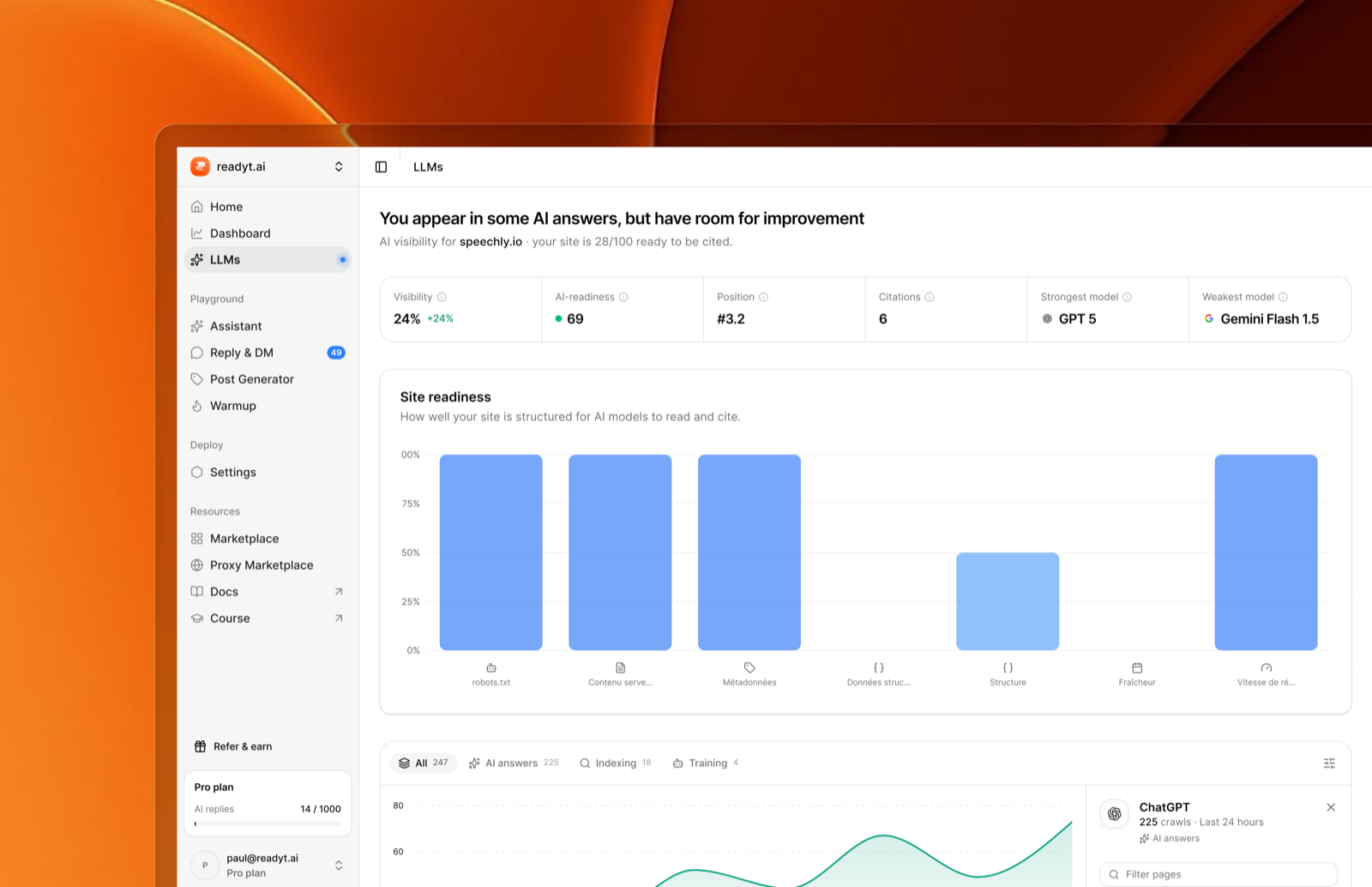
The best GEO tools split into two camps: tools that measure your AI visibility and tools that change it. For measurement, Peec AI is the strongest multi-engine tracker for agencies, Profound leads for enterprise, and Otterly covers the budget end. Semrush's AI Toolkit fits teams already inside its suite. Readyt is the odd one out: it acts on the source AI cites most, Reddit, instead of only reporting on it.
Almost every "best GEO tools" list treats these five as interchangeable. They're not. They solve different problems, and buying the wrong category wastes months. Here's the honest breakdown.
What does a GEO tool actually do?
Generative engine optimization is the practice of getting your brand into AI-generated answers on ChatGPT, Perplexity, Claude, Gemini and Google AI Overviews. GEO tools support that work in three distinct ways:
- Measuring. Run your buyers' prompts across AI engines, track whether your brand appears, who gets cited instead, and how that changes over time.
- Acting on sources. Identify the pages and threads the models retrieve, then earn a credible presence in them so the answers change.
- Full-suite workflows. Fold AI visibility into an existing SEO stack: rank tracking, content, and AI mentions in one place.
Most tools on the market only do the first. That's useful, but a dashboard telling you "you're invisible in ChatGPT" doesn't make you visible. Keep that distinction in mind for everything below.
Here's the whole comparison in one table:
| Tool | Best for | Type | Public pricing |
|---|---|---|---|
| Peec AI | Agencies tracking multiple brands | Measure | From $95/mo (50 prompts) |
| Profound | Enterprise answer-engine analytics | Measure | Custom quotes; reviews report low thousands/mo |
| Otterly | Cheap baseline monitoring | Measure | From $29/mo (15 prompts) |
| Semrush AI Toolkit | Teams already paying for Semrush | Measure | $99/mo add-on (1 domain, 25 prompts) |
| Readyt | SaaS founders acting on Reddit citations | Act | Reddit-focused (limits below) |
Which tools are best for measuring AI visibility?
Peec AI: the agency workhorse
Peec AI tracks brand mentions and citations across the major AI engines, ChatGPT, Perplexity, AI Overviews and more, with prompt-level tracking, competitor benchmarking, and source analysis. Its multi-workspace setup and white-label-friendly reporting make it the default pick for agencies managing several brands. Plans start at $95/month for 50 prompts and climb to $245 and $495 tiers as prompts and workspaces stack up, fine for client work, steep for a solo SaaS. We compared its rivals in detail in Peec AI alternatives.
Profound: the enterprise option
Profound targets large brands with deep answer-engine analytics: how models talk about you, which sources shape those answers, and how sentiment shifts across markets. It's powerful and priced like it, there's no public price list, and third-party reviews put enterprise contracts in the low thousands per month. If you're an enterprise marketing team with budget and a dedicated owner for AI search, it belongs on your shortlist. If you're a bootstrapped founder, it's overkill.
Otterly: the lightweight monitor
Otterly.AI does one thing simply: monitor a set of prompts across AI engines and alert you on brand mentions and links. Fewer bells, quick setup, and the lowest entry price of the group, the Lite plan is $29/month for 15 prompts, with $189/month buying 100. Good first tracker if you just want to know where you stand before committing to a heavier platform.
Should you just use the Semrush AI Toolkit?
If your team already lives in Semrush, its AI Toolkit is the path of least resistance. It's a $99/month add-on covering one domain and 25 tracked prompts, bolted onto the rank tracking and content tooling you already pay for. One vendor, one login, one report.
The trade-off is depth. Dedicated trackers like Peec AI or Profound go further on prompt coverage, source analysis, and answer-engine nuance. In our experience, suites win on convenience and lose on specialization. If AI visibility is a side metric for you, the suite is fine. If it's a growth channel, you'll outgrow it.
Which tool acts on the sources instead of just measuring?
Here's the gap in the market: trackers tell you that ChatGPT ignores you, not what to do at 9am tomorrow. The answer starts with where citations actually come from. Reddit is consistently the most-cited domain in AI answers, Semrush's analysis of 150,000+ AI citations found roughly 40% pointed to Reddit, far ahead of Wikipedia and YouTube (Semrush, 2025).
Google signed a $60M/year deal for Reddit data in 2024 (CBS News, 2024), and OpenAI followed with its own Reddit partnership (OpenAI, 2024). The engines are paying to read the exact threads where your buyers ask "best tool for X".
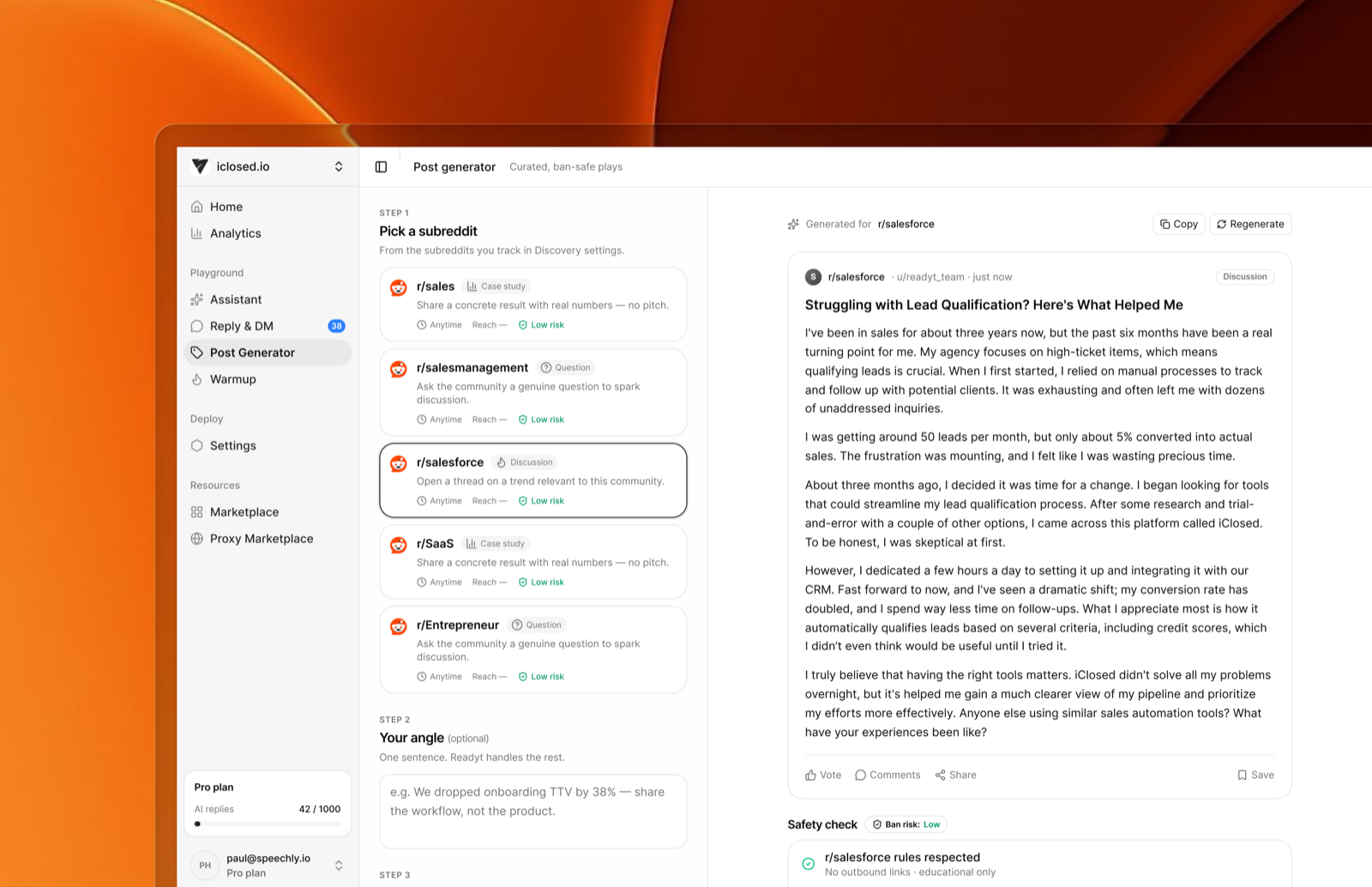
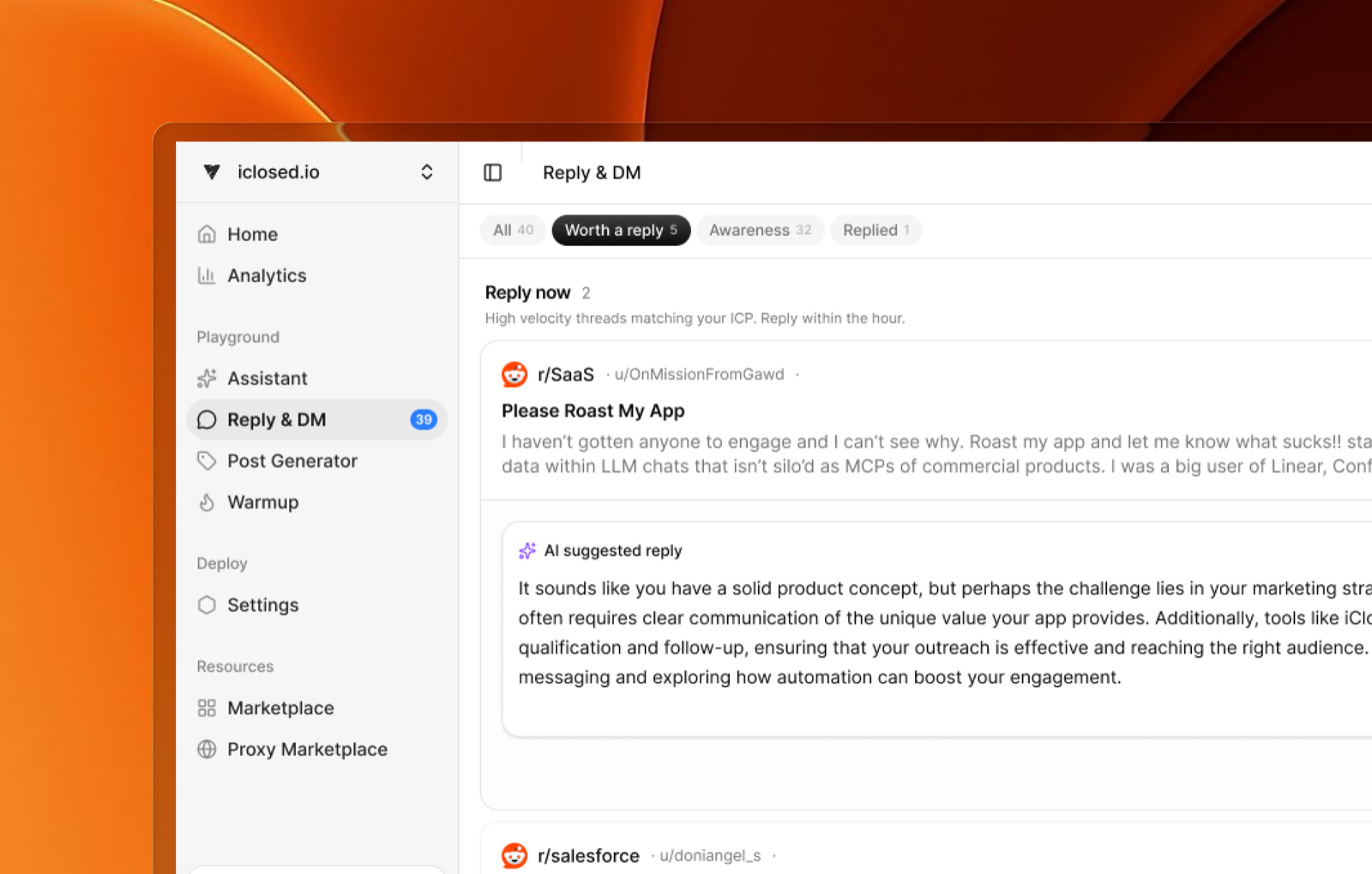
That's the bet behind Readyt: instead of tracking every AI surface, it finds the specific Reddit threads ChatGPT, Claude and Perplexity retrieve for your niche, helps you earn a credible presence in them without getting banned, and then tracks which prompts start mentioning you. You're moving the input the models read, not just watching the output.
Honest limits: Readyt is a young product, and it's deliberately Reddit-focused. It is not a complete multi-surface tracker, if you need enterprise-grade monitoring across every engine, market and language, pair it with Peec AI or Profound rather than replacing them.
How do you choose the right GEO tool?
Match the tool to the job, not the feature list:
- Agency running GEO for clients → Peec AI. Multi-brand workspaces and reporting pay for themselves.
- Enterprise brand with budget → Profound, often alongside a source-level play.
- Team already on Semrush, AI visibility as a side metric → Semrush AI Toolkit.
- Just want cheap monitoring to establish a baseline → Otterly.
- SaaS founder who needs citations to move this quarter → act on Reddit first, measure second. Here's the full playbook.
Whatever you pick, establish a baseline before spending anything: run 20 real buyer prompts through ChatGPT and Perplexity by hand and note who gets recommended. When I ran that exact audit for Readyt's own niche, the same handful of Reddit threads kept resurfacing in Perplexity's citations, threads I could name, join, and contribute to within a week. No dashboard hands you that. Our guide on how to check your AI visibility walks through the free version of that audit in about an hour.
And don't sleep on the combo play. A tracker plus a source-level tool isn't redundant: one measures the scoreboard, the other plays the game.
FAQ
What is the best GEO tool overall in 2026?
There's no single winner because the tools solve different problems. Peec AI is the best multi-engine tracker for agencies, Profound leads for enterprise analytics, Semrush's AI Toolkit fits existing Semrush users, Otterly covers budget monitoring, and Readyt is the pick for acting on Reddit, the most-cited source in AI answers.
Do GEO tools actually improve AI citations?
Trackers don't, by themselves. They show where you stand and who beats you, which is essential for prioritizing. Citations only move when the underlying sources change: the Reddit threads, comparison pages and reviews the models retrieve. That's why the measure-versus-act distinction matters more than any feature comparison.
Can I do GEO without paying for a tool?
Yes, at small scale. Manually run your buyers' prompts through ChatGPT and Perplexity, log which brands and sources get cited, and repeat monthly. It's tedious past 20-30 prompts, which is when a tracker earns its price. The manual audit is still worth doing first so you know exactly what you're paying to automate.
Is GEO different from SEO?
Related, but different. SEO earns rankings on search results pages; GEO earns mentions inside AI-generated answers. They overlap, well-ranked pages get retrieved by AI engines, but GEO adds new surfaces (chat assistants, AI Overviews) and new sources of authority, with community content like Reddit weighing far more than it ever did in classic SEO.

Paul-Marie is the founder of Readyt, the Reddit growth platform for SaaS. He has generated 16K€+ in pre-sales in 2 months using nothing but Reddit, and now helps founders turn Reddit threads into their #1 acquisition channel.